For International Women’s Day 2025, I was lucky enough to be judged the winner of a poetry competition.
It happened over a week – I entered the end of one week under my pen name, Bassi Meri, was told I had won it by Thursday and then read it to an audience on Saturday.
It took 10 minutes to write it.
Nope, I did not just rush it off because the deadline loomed. It sort of burst out, fully formed. Why? Because, although it was International Women’s Day, it was not open exclusively to women, and that the theme was about women who inspired, or the experience of women today.

It felt to me that women have to be inspiring to be given a voice. They can’t be ordinary. They still have to be better at being ‘men’ than men. Being a good women is not enough. Fingers are pointed at mothers when family life goes wrong, not fathers. Our media is saturated with the male gaze – at women and family life.
It reminded me that it took four attempts at the Swindon Think Slam! final (a philosophy competition, judged by selected members of the audience) for me to stop being the runner up and win in 2019. After one particular loss where people – including the male winner and the competition organiser – came up to me at the end, utterly confused as to why I wasn’t awarded the winner’s cup, my friend, aghast, remarked, ‘a dog would win if it were between you and the dog’.
For the past week, I’ve been thinking about sharing my winning poem, because it feels like it should be spoken aloud, to have a moment with the women listening. When I’ve shared this poem with friends and family, they’ve laughed at the first line. It feels like a moment of solidarity, a palate cleanser before the serious point.
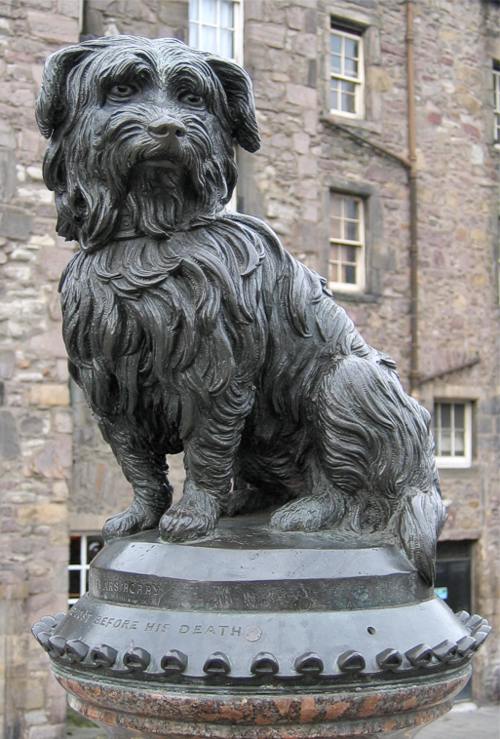
So today I’m sharing the poem because the common frustration behind it is happening very publically in Edinburgh. The Royal Mile and city centre has no statues of women. A dog, a bear and a Midlothian football team emblem, Scottish philosopher David Hume and many other men, but no women. A female-led campaign in 2017 tried to correct this problem, fundraising for a commemorative bronze of Dr Elsie Inglis, Scottish suffragist and maternal health pioneer. The charity in charge of the campaign led an open commission to find a sculptor and all went well until two weeks before the closing date in 2022.
But a conversation with the King’s Sculptor in Ordinary in Scotland, Alexander ‘Sandy’ Stoddart, led to, might I suggest, the charity’s trustees becoming rather starry-eyed with the internationally renowned sculptor and worried, perhaps, by the backlash on other recent statues of women. Perhaps also they wanted an easy time of it when they submitted their planning application – Sandy is responsible for five Royal Mile bronze works.
Sandy said he would be interested in doing the work himself, and that was it. “Given his proven record of producing inspiring monuments it was clear to the trustees that this was the way to provide the appropriate legacy for Dr Elsie Inglis, the key objective of the campaign.” said a spokeswoman for the charity.
‘The key objective’ – what, to tick the box saying ‘woman statue in Edinburgh town centre’?
Three years on and the sculpture design was finished and submitted to planning. The result was as you’d expect from a sculptor who is known for his classical work and a documented hatred for modern styles. There is nothing about Sandy that would suggest he knows about women’s suffrage or has any feelings for female pioneers who had struggle against the prevailing patriarchy. I’m sure, with its tall plinth, emphasis on her war work and classical portraiture, it will fly through planning. It will blend beautifully in with the other bronze statues. It will challenge nothing. It will say nothing other than she lived and did something. It will remark on how she looked after men while they fought but nothing about how difficult it was in Victorian and Edwardian times, and still is, to be a woman in public life and how remarkable it was that she achieved what she did in spite of all her disadvantages due to the body she inhabited. It will tick the box saying ‘woman statue in Edinburgh town centre’ and plenty of women will have bought into that as an achievement and made their peace with it, consciously or subconsiously.
Three years it has taken Sandy to draw a statue of a woman in a military outfit from Elsie’s Wikipedia page, stick it on a plinth and have a man in a 1950s suit look on approvingly. I wonder if he considered that Elsie will be installed on the site of the maternity hospital founded in her name after her lifetime campaigning and caring for women, including her own dying mother? Or that she was one of the first female graduates from Edinburgh University, not because women weren’t any good at academia but because they weren’t allowed and needed a wealthy father to champion them. It looks like Sandy realised the deadline was coming up, couldn’t procrastinate further over this difficult project he had little affinity with, and needed to put something on paper, quick. (If you want to see how it could be done, read this by me, about a statue completed by women sculptor Moira Purver)
“It’s incredibly important that women’s stories are told through the female gaze. When men create sculptures of women, they often portray them through the patriarchal lens, whether intentionally or not,” said sculptor and campaigner Natasha Phoenix.
“For me, the problem isn’t that he’s a man but that he was selected by the trust after they said it would be a competitive process,” Jenny Lester, chair of Edinburgh’s International Women’s Day march.
Well, yes, it is a problem that a man was chosen. Let’s be ok with saying that.
I want men to go back to portraying men. I want women to write about women, and I want these women to be given at least 50 per cent of publishing deals, show-running, directing and art commissions. I’m reminded of a day’s workshop with a best-selling author who’d made his name with a novel with a female lead character. I recommend men write women and women write men, he said. I disagree. We need more women to write about women. We women know all about the male perspective because what they think and their friendless, male-attached women are drenching us, day in day out – what’s important, how to think about women, how women should dress, what they are to blame for. We should no longer settle for secondhand women in art, literature and film.
So, thank you to Shouting Softly Swindon and all the amazing women who were part of the project to give me a competition to enter. They said my poem reflects the experience of women today. Here’s my poem. I genuinely hope you laugh.
I bet a man wins this
With his masculine techbro aggressive peace energy.
He wrote about his mum whose greatest achievement was him.
I’m an ordinary woman; I’m not inspiring, I haven’t done great things.
Just raised two kids and looked after a dying mum, and tried to be a good friend.
I haven’t saved the universe or even the world, or held a high powered job.
Yesterday I rescued post-hibernation toads sitting on the road on the way back from my shift in the community shop.
Then I wrote this poem and a Man Googled how to write a winning poem and read it out to me.
Speak it loud in a low voice, he said, so it carries to the back of the hall. He spoke every word as truth. Replied to my story with his story.
I ignored him so a man could win.
Bassi Meri, 2025
Featured image: Dr Elise Inglis, by Lady Francis Balfour.
 Agent Louisa